
X_HeERO – Next-Generation eCall
Next-Generation eCall Meets Autonomous Driving: Our Live Demonstration in Braunschweig
What actually happens if an autonomous vehicle is involved in an accident—and there’s no one behind the wheel who can make an emergency call? This very question was the focus of our most recent demonstration as part of the EU project X_HeERO (eCall Next Generation), which we at HILYNX conducted together with our consortium partners.
Why eCall Needs to Be Rethought
The pan-European eCall system was a milestone for road safety: In the event of a serious accident, the vehicle automatically sends an emergency call to the public safety answering point (PSAP) and transmits a standardized Minimum Set of Data (MSD) containing the vehicle’s location and vehicle data. However, much has changed since then. Mobile networks have transitioned from 2G/3G to 4G and 5G, and with automated driving at SAE Levels 3 through 5, the system’s fundamental assumptions are changing drastically. A highly automated vehicle may operate entirely without a driver or even without any occupants. Who, then, triggers the emergency call? How does communication with the control center work? And what information do emergency responders need to provide effective assistance?
Next Generation eCall (NG eCall) addresses these issues through IP-based communication, richer data formats, and greater flexibility for different vehicle technologies and accident scenarios.
From Workshop to Scenario
We had already defined the scope of our demonstration back in September 2025 during a workshop using the Cross-Impact-Balance (CIB) method. Based on five system dimensions—sensor technology, communication, MSD, vehicle class, and number of passengers—the most consistent configuration was a vehicle with L-5 sensors, modern 4G/5G/6G communication, and an expanded MSD, designed for M2/M3-class shuttle vehicles carrying more than one passenger. From this, we derived two specific scenarios:
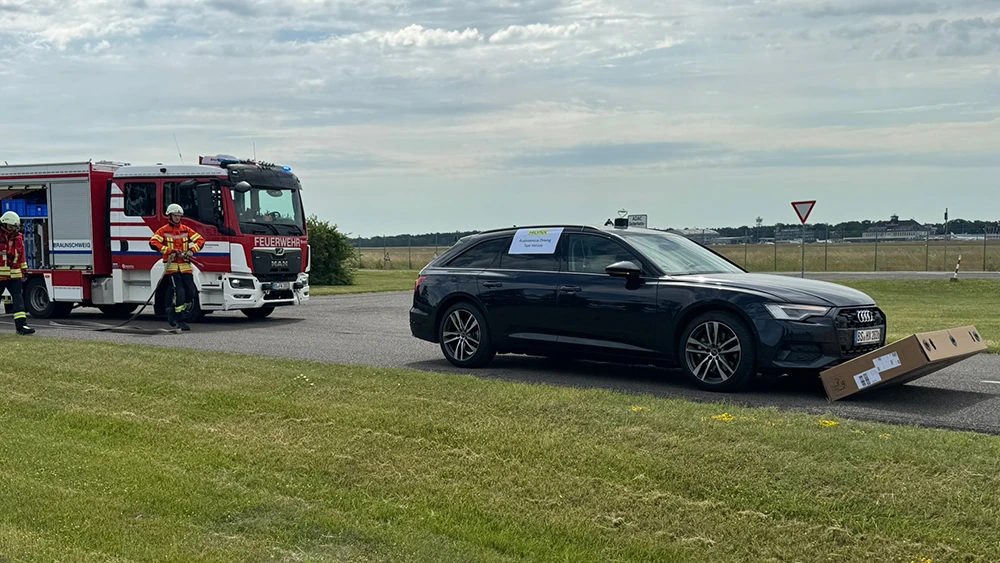
In the first scenario, the lane departure, the vehicle leaves the lane due to a simulated sensor malfunction and comes to a stop on its side. In the second scenario—the collision—the vehicle strikes an unexpected obstacle on the road. Together, these two scenarios cover a wide range of real-world accident scenarios.
The Structure
At the heart of the demonstration was the on-board computer from our consortium partner Radcom, which combines all the functions of intelligent transportation systems into a single device. As the system integrator and work package leader, HILYNX contributed the expertise needed to test this device—originally developed for public transit—for use in autonomous vehicles. To expand Radcom’s system, we mounted a 360° camera on the roof—to simulate the visual sensors of an AV. Its video feed is a central component of our proposal for an expanded MSD.
The demonstration at the traffic training ground
The demonstration was conducted at the Braunschweig traffic training center—an ideal setting for controlled driving tests. In both scenarios, the process went off without a hitch: The vehicle encountered an emergency situation, activated its hazard lights, triggered the eCall, and transmitted the expanded MSD—enriched with a video feed—to the control center. The eCall test server provided by our partner oecon displayed the transmitted data in a human-readable format. The Riddagshausen Volunteer Fire Department assumed the role of the emergency dispatch center, assessed the situation, and took the necessary measures—with the procedure varying depending on whether the vehicle was occupied: An unoccupied vehicle can be towed, while first aid must be administered to occupants.
A simulated use case: Protection for vulnerable road users
In addition, our partner CTAG demonstrated a simulated use case in an urban setting in which an autonomous vehicle uses its sensors to detect nearby pedestrians. The core of the idea: an additional data block in the MSD that provides emergency responders with information about detected vulnerable road users (VRUs)—estimated number, relative position, and estimated status (moving, motionless, or unknown). Three principles are upheld in this process: the existing MSD remains compatible, no images or personally identifiable information are transmitted, and the data volume remains compact—a maximum of 33 bytes for up to 15 detected VRUs.
What’s Next
The demonstration day was rounded out by a panel discussion featuring experts from legal, technical, and communications backgrounds. Key areas of focus for the future include: the specific design of the expanded MSD while taking data protection into account, the interaction between emergency responders and autonomous vehicles, redundancies in the event of network outages (such as via V2X or V2V communication), and the handling of false alarms through feedback loops to manufacturers.
We would like to extend our special thanks to the Riddagshausen Volunteer Fire Department for their participation in the live demonstrations, as well as to the Braunschweig Traffic Training Center for providing the test site.
The demonstration showed that the eCall system can be meaningfully further developed for the era of autonomous driving—and provides valuable impetus for the standardization of an expanded MSD.